Issuing a Stellar asset
Volta Circuit can issue a new Stellar asset from one of your vaults. A throwaway account creates the asset, hands control to your vault, and is then locked permanently. What that leaves is an asset whose only administrator is the vault — so minting more, or changing its settings, needs the same owner approvals as any other vault action, and no individual keeps power over it.
Before you start
Issuing creates a throwaway Stellar account, so the wallet you sign with needs roughly 4 XLM available on top of its own reserve. The unused remainder comes back to you at the end, but the deployment cannot begin without it.
What you provide
-
Asset code. One to twelve letters or digits, for example
MYTOKEN. This is how the asset appears in wallets and explorers, alongside its issuer. -
Home domain. The domain hosting your
stellar.toml, such asexample.com. Wallets read that file to show a name, logo and contact details instead of a bare code, so an asset without one looks anonymous. - Amount to mint. Optional, up to seven decimal places, delivered to the vault. You can leave it empty and mint later, because the vault keeps the ability to mint.
- Internal memo. A private note for vault owners. It is not published on-chain.
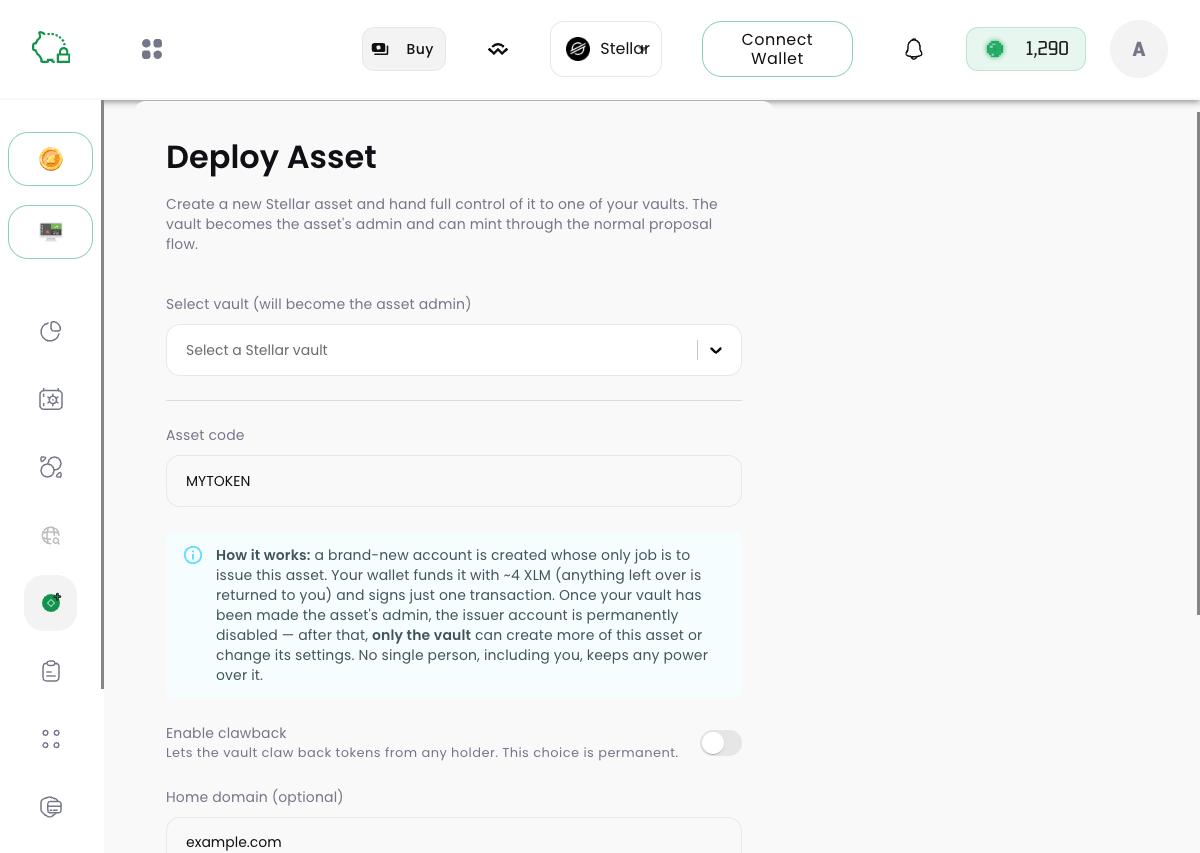
Clawback
Enable clawback lets the vault take the asset back from any holder, later, without their consent. It is off by default, and the choice is permanent: it can only be set while the asset is being created, because the issuing account is locked immediately afterwards.
Regulated issuers often need it — to satisfy a court order, or to recover tokens sent to a wrong address. For a community token it is usually the wrong choice, because holders can see the flag and will read it as "this can be confiscated".
What it sets on the asset
Turning it on sets two Stellar authorization flags together, rather than one:
AUTH_CLAWBACK_ENABLED— the flag that permits clawing back balances.-
AUTH_REVOCABLE— required by the protocol before clawback can be enabled at all.
They are one switch in Volta Circuit because Stellar will not accept clawback without revocability, so offering them separately would only let you build a combination the network rejects, or one that implies a power the asset does not actually have. Leaving clawback off sets neither flag.
What happens when you deploy
- A temporary issuing account is created for this asset alone.
- Your wallet funds it with about 4 XLM and signs one transaction. Whatever is left over is returned to you, but you need that balance available before you start.
- The amount you entered is minted to your vault, if you entered one.
- Your vault becomes the asset's administrator, holding the rights to mint and to change the asset's settings.
- The issuing account is locked permanently. Its key can never sign again, so control cannot be exercised from outside the vault — not by us, and not by whoever ran the deployment.
- Leftover XLM is returned rather than stranded on the temporary account.
After issuing
The asset behaves like any other Stellar asset. Classic accounts that want to hold it add a trustline
to your code and issuer; contract accounts, including other vaults, do not need one. You pay it out
from the vault like any other balance. Publishing a
stellar.toml at your home domain is what turns it from an unidentified code into
something wallets can display properly, so do that before distributing.
Swapping assets
Where swaps are enabled, a vault can trade assets it already holds without moving them out first. Open the vault, choose Swap, pick the assets and amount, and review the quote — it shows what you receive before you commit.
A swap is a vault transaction like any other: it becomes a proposal and needs the same threshold of approvals. Quotes reflect market conditions at the time they are fetched, so the amount received can move between quoting and execution.